Field Report: AI-Mediated Coordination in a Volunteer Nonprofit
By Rob Gordon ·
Background
At BRKT Lab (pronounced bracket) we build tools for social fabric, from small groups to societies. On the scale of group collaboration, one hypothesis I hold is that groups lose energy over time because of a bidirectional legibility gap: individuals can’t see themselves reflected in the group’s activity, and the group can’t see the full texture of its members. This winter I received a grant to research coordination technologies, so I challenged myself to build something to address this gap. The tool that came out of that research was Cadence.
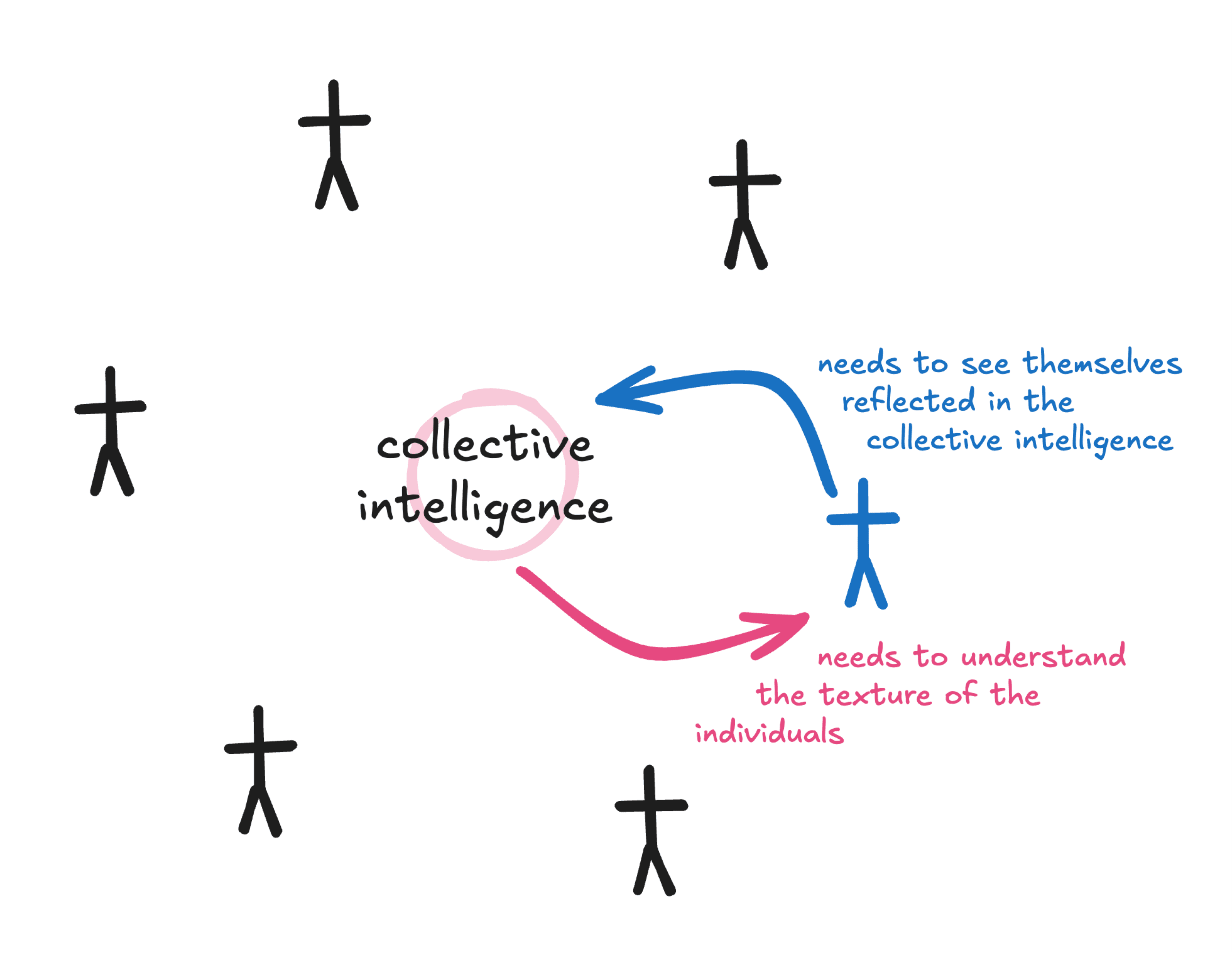
I’m inspired by apps like Talk to the City and Polis, which aggregate collective opinion on issues. Where those apps ask what do people think?, Cadence asks something narrower: what’s happening for you right now? What are you going through? In that sense, Cadence doesn’t ask you to participate — it presumes you are participating, and helps contextualize your work to create mutual legibility and strengthen the bonds of the collective.
How Cadence Works
The testable specification went something like: could extremely small (in terms of time required) daily interventions create a feedback loop that would slowly bring an organization into better coherence? Could tracking what was alive for members, while showing them what was happening around them, strengthen the social fibers of the collective?
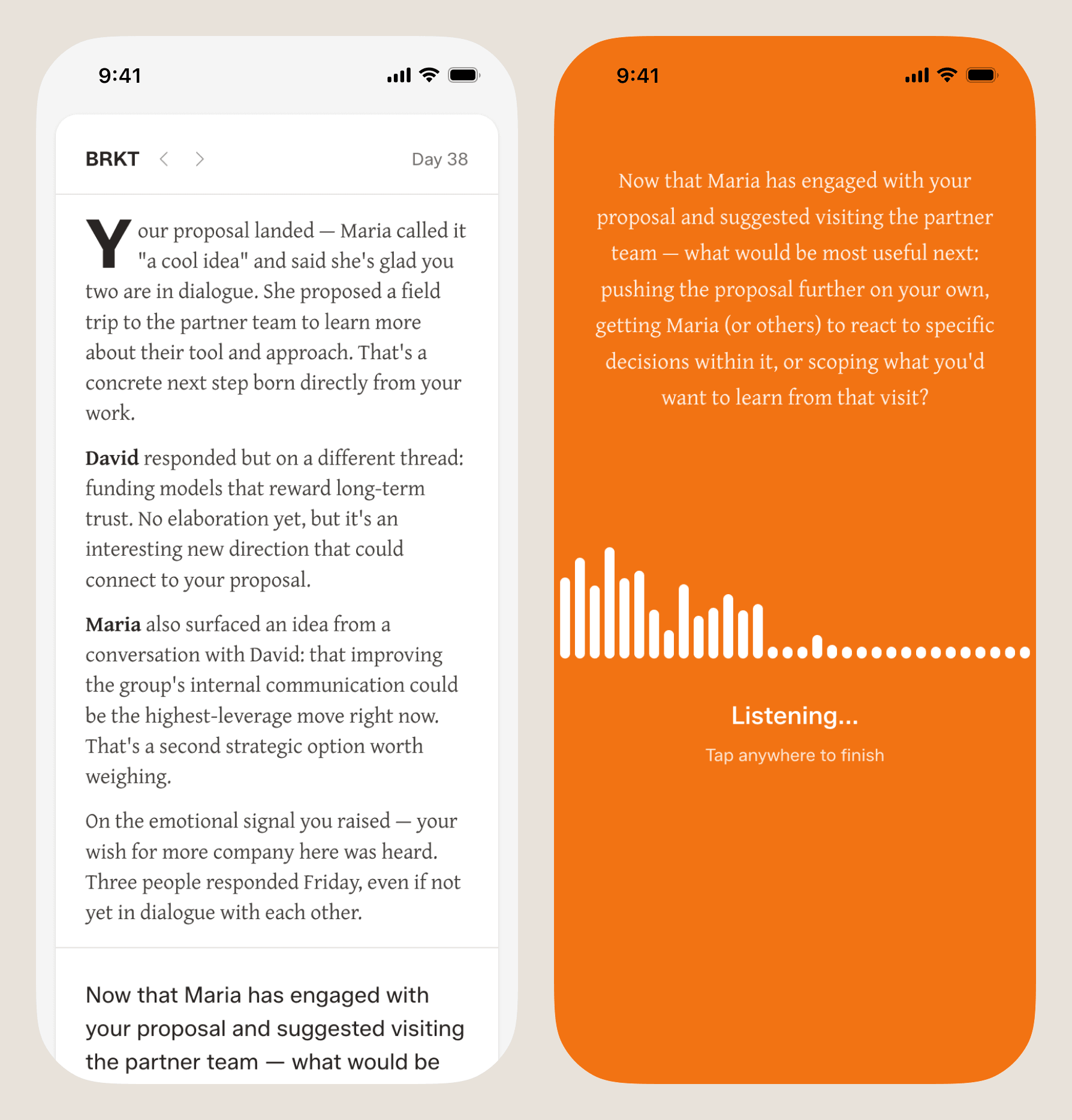
Each day, every member gets a short AI-generated prompt — a question about what’s on their mind, or what they’re working on. They respond (by typing or voice memo), and the AI synthesizes everyone’s responses into a living picture of the group. The next day, along with a new prompt, each member gets a personalized digest — a reflection of the group’s state, shaped to what matters to them. Over days and weeks, these digests accumulate into something richer than any single meeting could produce.
Putting Cadence to the Test
BRKT meets daily and has built tons of shared context. We used Cadence internally early on, but quickly hit a ceiling — the tool wasn’t built for a team already swimming in each other’s thinking. We needed a group that actually had the problem Cadence is designed to solve: too little shared awareness.
Kind Sun is an all-volunteer nonprofit that refurbishes discarded solar equipment and installs it in underserved Caribbean communities to strengthen energy independence. All eight members have day jobs. They’re fully remote and meet just once a week. Most come from labor organizing backgrounds. Where BRKT is four tech workers between 35 and 45, Kind Sun’s members range from 25 to 65 with varied amounts of tech experience.
Kind Sun’s leaders, Misha and Drew, were excited to try it. They got the whole team on board for a two-week pilot starting in late February.
Experimental Design
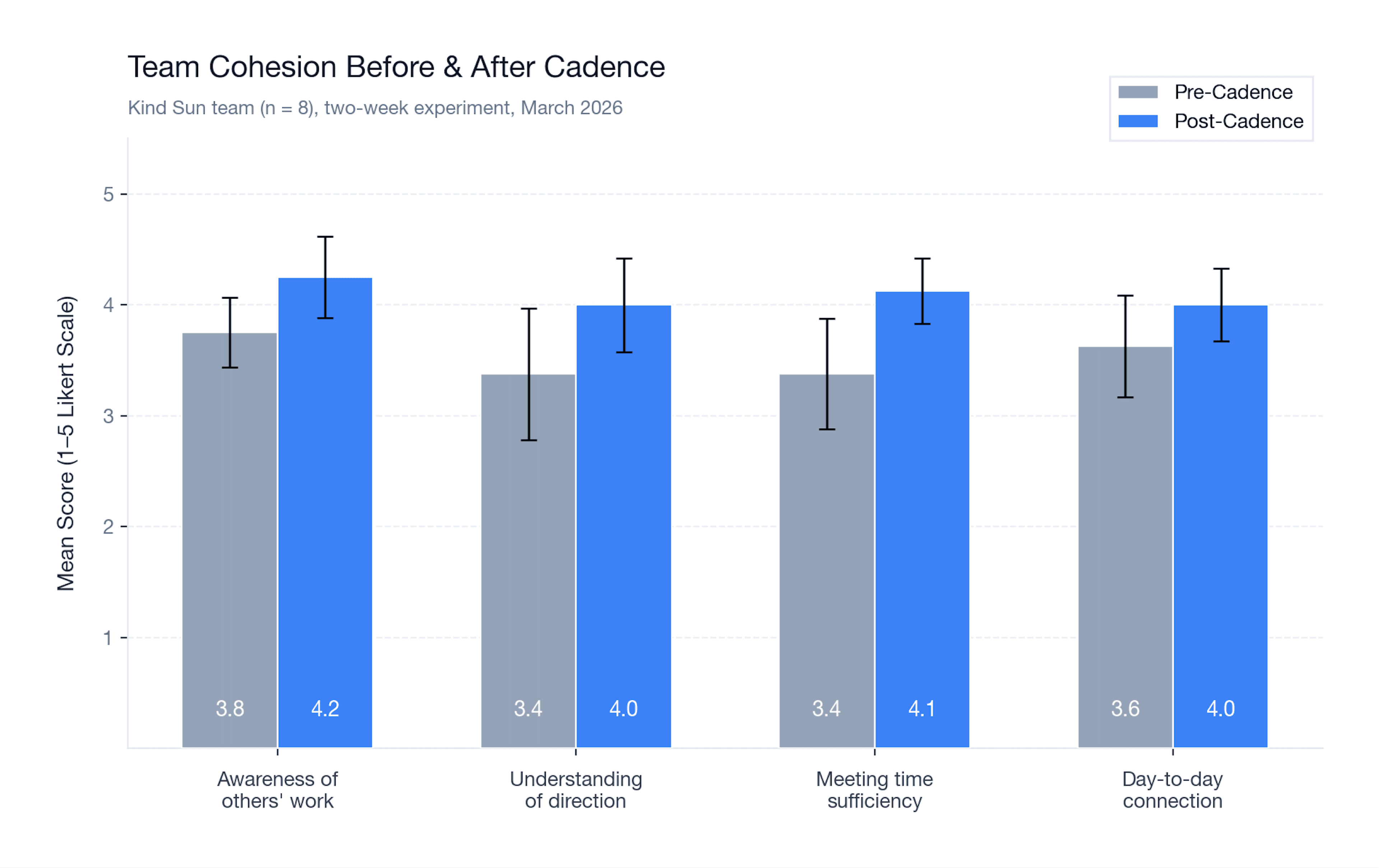
We boiled our strongest intuitions into some concrete hypotheses that we could test with a pre- and post-survey.
- Visibility — I have a good sense of what other Kind Sun members are working on between meetings.
- Alignment — I feel like I understand where Kind Sun is headed and how my work fits into that.
- Horizon — Our Monday meetings give us enough time to talk about Kind Sun’s bigger picture and direction.
- Presence — I feel connected to Kind Sun on a day-to-day basis, not just during meetings.
During the two weeks before the experiment I went to Kind Sun’s meetings and explained what Cadence was and how it worked. Onboarding was not easily won — simply getting everyone to download the app and understand what it was took real effort. Eventually everyone was ready to go, and the experiment kicked off.
What happened on paper
Usage was stronger than I expected. The first week averaged over 5 responses a day out of 8 members. It tapered in the second week, but I chalked that up to the novelty wearing off. The overall picture felt encouraging.
The pre-and-post survey data was also promising. On most of our hypotheses, the needle moved in the right direction. After two weeks using Cadence people reported feeling more connected and more aware of what others were doing. The digests were doing their job. Several members described a moment of takeoff around day two or three, where the digests went from vague to seriously useful.
On the product side, the voice memo feature was a hit. Drew, who championed it most, said that even when he’d pause or stutter, the system would sanitize it really well. José, another member, would later say that switching to voice memos might make the whole thing more usable — “like a new bike, it takes time to learn how to ride it.”
If I were pitching this app I would probably stop my presentation here…
What really happened
In the weeks leading up to the pilot I got to know the members of Kind Sun. They’re extremely kind people. So at the post-mortem meeting, it took a minute to break the ice.
I asked everyone how their experience was. Silence. Eventually the leaders chimed in and paid a few scattered compliments to the app and then the silence crept back in. From my experiences as an indie developer, I know how hard it can be to get honest feedback, so finally I jumped in: “Guys, you can’t hurt my feelings. I promise. Just give it to me straight.”
José was the first to step up. “I’m going to be honest, Rob. I didn’t like it. I didn’t like it at all.”
“It feels like it has a loop on me — like it’s watching me for some reason.” The more input he put in, the more it seemed to ask of him. Grant, another member, made the most damning comparison — he said it was like Elon Musk’s “what are five things you did this week” email.
He went on to explain that being from a labor organizing background, part of his job had always been to protect workers from managerial surveillance — and this app felt like exactly that. He said it felt like it was tracking him (which in a way it was).
I had set out to build something that would create social cohesion and reduce meetings. It had been received like a top-down, managerially-driven surveillance app. 🤦
Once the ice broke, other frustrations surfaced. Amy described how the word ‘pending’ next to unfinished tasks made her feel like the system was yelling at her — and even though she knew the messages weren’t from her colleagues, she found herself momentarily transferring that feeling onto them. As volunteers with day jobs, they didn’t have time to advance Kind Sun tasks every day, yet Cadence was asking for daily updates, sometimes on milestones months in the future. Grant had been so frustrated at one point that Amy had to talk him down.
After some time to vent, bits of positivity started to show through the cracks. Grant, who had been furious, later compared Cadence favorably to Slack — “this one pretty much handpicks the cherries for you and displays them right in front of you. That’s the aspect I like. It saves you tons of time.” And José, the harshest critic, ended the meeting by saying he wanted to keep using it. They had, in a very real sense, been brought closer together by their shared irritation with the tool. I guess that’s the cohesion effect I was going for.
Top-Down / The Bigger Picture
Negative feedback is often a much richer signal than positive, and in this case the negative was extraordinarily rich. The people who reacted most strongly — José and Grant, the members with the deepest union backgrounds — had spent careers protecting workers from exactly the kind of monitoring this tool accidentally resembled. Their resistance wasn’t a failure of onboarding or UX. It was a historically informed response to a pattern they’d seen before: technology deployed from above, justified as being for everyone’s benefit, that ends up being used to extract more from workers.
Towards the end of the meeting, a member said “If it’s an employee-generated workflow rather than a management-dictated workflow, you’re generally going to get more buy-in and more use from the users.”
They were right. The two leaders had mandated participation, and in doing so, they’d made a top-down move without calling it one. I had been so focused on the tool itself that I’d missed the deployment conditions entirely. You can’t build agency-inspiring technology and deploy it through authority.
But the more I sat with it, the harder it became to separate the deployment mistake from a much older pattern. The relationship between new technologies and capitalism has an awkward track record: tools that promise to give workers back their time and instead get used to extract more from them instead. That’s a pattern I don’t know how to break.
The surprising reaction to Cadence as surveillance-tech is the result of Kind Sun meeting a new technology and immediately recognizing the shape of an old one. If by gaining time through tools like these, executives then decide to force people to do more work to make more money, we’re back to an old and very well-rehearsed rug-pull of capitalism encountering technological progress. From a systems perspective, it undermines the goals of trying to create spaciousness — the entire point of Cadence.
Next Steps
I don’t have a good answer to the rug-pull problem. But I have some design hypotheses I’m taking away from this experience:
- The tool has to match the rhythm of the group, not impose one.
- The generative parts should feel human. The productivity parts should feel like furniture.
- People need to see inside the machine to feel at peace with it.
- The tool has to feel like it belongs to the group, not to management.
- The tool should carry context for you and help you participate on your own terms — not direct the conversation.
These aren’t solutions. They’re open questions I’m continuing to work on — and I think they’re questions anyone building coordination tools will eventually have to face.